By Karima Kadaoui, 2018 reviewed and edited by Karima Kadaoui & Yassin Amzou 2026
“We are the Gardener And the Garden” captures the essence, substance, sustenance, and dance of the Tamkeen approach (The Tamkeen experience, process and approach – link) .
There are moments when an entire way of seeing the world reveals itself through a realization that finds its words, because it opens a field in which everything may be seen with different eyes. We are the gardener and the garden is one such sentence. Its center of gravity does not rest on gardener, nor does it rest on garden. It rests on the quiet word in the between: And. A word so familiar that it often disappears into the background of language, yet one that carries a profound invitation. It asks us to linger in relationship, in reciprocity, in mutual becoming.
“You think because you understand 'one' you must also understand 'two', because one and one make two. But you must also understand 'and'.”
― Mawlana Jalal-al-Din Rumi
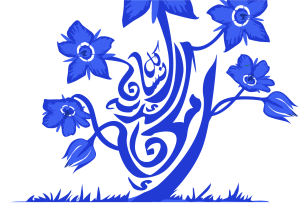
In Arabic grammar, and و (pronounced wāw) is known as حرف عطف (ḥarf ʿaṭf). It is often translated simply as a conjunction, but the Arabic word ʿaṭf carries a richness that grammar alone cannot contain. Its root speaks of bending toward another, inclining with care, joining without dissolving difference, even embracing with tenderness. It is a connection that preserves the uniqueness of each while allowing them to belong together. It invites us to dwell in the relationship that allows each to become more fully itself. There is another quiet resonance within the Arabic language. The vowel mark ḍamma (ضمة), whose graceful form resembles a tiny wāw, comes from the root ضمّ, meaning to gather, to draw close, to embrace, to bring together. Whether read through language, calligraphy, or metaphor, the invitation is remarkably consistent. Arabic repeatedly points toward the attribute of relationship. The language itself becomes a living metaphor for its own wisdom. Tamkeen articulates this grammar of wisdom.
When we co-founded Tamkeen for our Humanity Foundation (formerly Tamkeen Community Foundation for Human Development) (See: Ism Ala Mussama-The Name Upon The Named) we understood, that we cannot change systems, however we can create the conditions for the change, in a similar way that we do not grow a garden, we create the conditions for the garden to grow itself through thoughtful landscaping, composting, soil nurturing and watering. Our co-reflection of our former experiences that led to our phenomenological introspection in 2009 (See: Genesis) moved us from a language of engineering to a language of gardening. A few years past, and during one of our Monday team co-reflection of our lived experiences we recalled that we are the gardener and that we co-create the conditions for the garden to realise its beauty. My colleague and friend Christina Grandegger a systemic psychologist said, “but Karima I do not experience Tamkeen like this, we co-create conditions with our partners”. It doomed upon us all that our metaphor was incomplete if not misleading and did not resemble our lived experience. The garden gardens itself, creates the conditions of its blossoming. The taller trees shelter the shy seedlings from scorching sun, their fallen leaves nourish the soil, their root systems distribute water, flowers wave to bees with their scent and colours at the delight of surrounding plants: the gardener co-creates conditions together with the garden.
We further widened our gaze, co-reflecting our lived experience growing a shared understanding with our partners in flourishing; communities, societal and governance systems in Morocco and beyond. We recognised that the gardener enters the garden believing it has come to cultivate it however, season after season, almost imperceptibly, the garden begins cultivating the gardener. The soil teaches patience because it cannot be hurried. The seed teaches trust because its unfolding remains invisible long before it becomes visible. The changing seasons teach surrender because no amount of effort can command spring to arrive before its time. And this kind of surrender is love. Resting in this love, being and knowing cease to stand apart. We discover ourselves learning through becoming and becoming through learning. Agency is no longer conjugated in mastery but in the humility of the humus of life.
The logopoeisis of Tamkeen (See: The Meaning of Tamkeen) reveals itself through and with our lived experiences seeking a language that resembles the experienced. The language becomes a reflection in which the meaning of the experienced can further become intelligible to itself. This language that has no final vocabulary because it is always realizing its grammar of becoming. It is a language of listening, of patience, of humility, of trusting our humanity and of profound, loving connection. Our language aware of itself dissolves the planes of being and knowing into one onto-epistemic cultivation: we are the gardener and the garden and we are learning to speak the language of and – as we grow our shared understanding.
Within this language, the one who accompanies is accompanied. The one who listens is changed by what is heard. The one who creates the conditions for growth discovers that those very conditions are quietly cultivating something within the self. Every encounter is reciprocal. Every reflection is mutual. Every relationship becomes a place where all involved continue becoming. This realization reflects a sense of self finding rest in love.
A living garden is never an object of attention. It is a watered ecology of conversations. Roots speak to fungi. Fungi amplify conversations. Water shapes stone. Fallen leaves become nourishment for futures they will never witness. Every life becomes part of another life. Nothing grows alone because nothing exists alone. Human communities are no different. Every conversation leaves traces within those who participate in it. Every act of trust enlarges the field in which trust becomes possible. Every reflection when shared reveals meaning and deepens not only understanding of the world but understanding of ourselves within and as one with the world. We began by imagining that we are cultivating community and society, only to discover that the cultivated and the cultivator are one.
Maybe reciprocity is the breathing movement of life. Perhaps this is what we continue to learn. The world is not held together by material things but by the beauty of the essence that flows relationships into being. We do not become human realising the beauty of our humanity alone. We become with. We reveal meaning with. We learn with. We understand with. We flourish with. The smallest word in the sentence continues to teach us the largest lesson. We are the gardener and the garden. We are learning to speak the language of and.